Showing posts with label education. Show all posts

Saturday, November 29, 2008

Week of November 23, 2008

Sick and tired of unwanted phone books (or want more?): While I spent time knocking on doors this fall, constituents had just received a new phone book and many asked how to avoid getting them. I worked on legislation on this issue in 2008 to give consumers the option to "opt out" of getting a phonebook. Since Dex has created a solution to give consumers the option of controlling how many, if any, phone books you would like to receive, I thought I would like to know how to go about it.

Dex has developed an online web page which allows users to find out which directories they are currently receiving and alter what type and how many they would like to receive in the future. There is also a link to the phone numbers for other directory publishers.

Here are the steps required to alter the amount of directories you receive.

Step # 1 - Go to www.selectyourdex.com
Step # 2 - On right hand side of the screen, enter your zip code
Step #3 - Near bottom of the screen click “Proceed to select your Dex link”
Step #4 - Fill out information on right side of screen. Under “Available Directories in Your Area” make sure you’ve checked the number “0” next to each listed directory if you do not want to receive anymore phone books. (You can also order additional directories if you choose.

Dex has a toll-free number (1-866-547-5100) available for anyone who would rather change their phonebook service via telephone rather than use the Internet. Other publications include Yellow Book (800-YB-YELLOW) and Verizon (800-555-4833).

Visit to District Court in Anoka: One of my constituents is a district court judge in Anoka, and she invited me to observe the court system at the Tenth Judicial District on Tuesday, November 25th. During the morning, I sat through about a dozen probation violation hearings, three short trials where drivers were contesting their tickets, and a few felony hearings for drug violations. There were plenty of defendants who I think probably were scared straight because of their experience with the criminal justice system, and there were a few people who were never going to get their act together. Two years ago I had the opportunity to tour the Lino Lakes prison, and I plan to do a ride-along with some local law enforcement agency soon, so I'll have the complete picture!

Centennial Community Education: I met with staff from Centennial School District regarding community education initiatives, such as "educational, recreational, social, and cultural programs [that] include enrichment classes, outings, drivers education, swimming lessons, and more." I was particularly interested in the Adult Continuing Education program, which includes help with GED preparation among other opportunities. Statistics about who is going back for a GED were particularly enlightening.

Schedule: No committee or working group meetings during this short holiday week

Visitors: A Senator regarding paratransit issues; constituent dentist about dental licensing policy; Centennial School District community education staff regarding their programs

Constituent contacts: Lino Lakes resident supporting Rule of 90 teacher pension legislation; two constituents reporting that pollsters called them asking about why they voted the way they did for the 53A race earlier this month; North Oaks resident reacting to story about the Fergus Falls school superintendent recruiting Chinese students; Shoreview resident about upcoming reconstruction of Highway 49 through Shoreview; Shoreview resident about the hazards of buying gift cards for retailers who are entering bankruptcy or who are closing for good; Shoreview resident supporting Wine with Dinner legislation to allow wine sales in grocery stores; Shoreview resident asking if I am a member of ISAIAH and whether I endorse its views (see link to organization on the right); Shoreview resident supportive of Blaine airport runway extension; Lino Lakes resident seeking additional financial support for K-12 education; Circle Pines resident supporting legislation to increase recycling of cans and bottles

Monday, May 12, 2008

Week of May 11, 2008

Session wrapping up: We experienced long days and nights on Monday, Tuesday, Thursday, Friday, and Saturday. The final loose ends are being tied up on most bills on the floor of the House and Senate. As of the evening of Sunday, May 18th, we have now passed the last four big bills remaining: the big budget-balancing bill (HF1812), the omnibus tax bill, the health care reform bill (vetoed once already), and a bonding bill that deals with Central Corridor, a veterans facility, and the Lake Vermillion Park. All four of these bills are linked together as part of the budget negotiations among the Governor, House, and Senate. I will do a separate blog entry in a day or two summing up the session.

K-12 education funding bill: On Tuesday, the House and Senate passed HF6 that would provide an additional $51 per pupil to our school districts in the next year. This would not be added to the traditional funding formula that distributes dollars according a complex set of variables--it's $51 per pupil no matter what district you're in. Rep. Garafalo (see photo) asked me a question on the floor about how this bill would affect Centennial School District, implying that the bill would hurt the district because of bill language about debt levy equalization. Since this is a common "gotcha" technique by the House Republicans, I kind of told him to stick it in a nice way, indicating that my constituents heard for 16 years why their previous representative offered excuses for why he couldn't support education funding bills, and that this argument sounded like one more excuse. In addition, the Governor already threatened to veto previous legislation that we had in 2007 would have "fixed" the debt levy equalization issue. Centennial advocates also e-mailed me indicating their support for the bill. Apparently my words hit home with some folks on our side of the aisle, and about 20-30 people thanked me for my comments!

Unfortunately, the Governor vetoed HF6 at 11:45 p.m. on Friday night. However, after day and night negotiations, this funding was restored in HF1812 as part of the deal among the Governor, House, and Senate on Sunday.

We grill the DNR over use of state resource on a conference: Readers may be familiar with the recent story about how the DNR used state resources to raise money for a game warden conference. The MN Conservation Officers Association was the host organization for the North American Wildlife Enforcement Officers Association in July 2007, and 304 employees from the DNR were required to attend the conference. On Friday (May 9), I was on the House Environmental Finance Committee that held an informational hearing on just what the DNR was doing on this conference. The Star Tribune had a follow-up article on Saturday in which I was quoted. Having hosted a national recycling conference in 2005, I know what is involved to organize these things, so I was outraged to see that the DNR was soliciting sponsorship on state time. This is illegal. But the DNR is going to hire an outside firm to investigate the situation, even though the Legislative Auditor is doing one anyway. The head of the enforcement division and his wife, who is also a DNR employee, have been put on paid administrative leave.

Legislature gets rid of major subsidies in Mall of America proposal: Due to major pressure from legislators in the House (including me), House leadership put together a new proposal to help finance a parking ramp for the Mall of America II project. Instead of filching money from taxpayers like us in the northern suburbs by tapping the "fiscal disparities" pool, the House and Senate have proposed having mall patrons pay an additional sales tax at the mall complex (since a parking fee was not acceptable to the mall) and a tax on lodging for hotels around the mall complex. The proposal also includes a requirement that employees at the new mall be paid a "living wage." This kind of puts the onus on the City of Bloomington, which has been seeking state funding for the mall and now would be the responsible party for raising these taxes. I'm not a big fan of subsidies for private businesses, but this is about the best result because it gets better wages for workers and avoids having the rest of us subsidize this business.

Bonding bill supports Rice Creek Chain of Lakes Campground/Visitor Center: Readers will know that the Governor used a line-item veto for completing the Rice Creek North Regional Trail in Lino Lakes in the bonding bill. However, one item that stayed in the bonding bill was funding for the Metropolitan Council for parks. This funding will result in the construction of a new visitor center at Rice Creek Chain of Lakes that will combine with the campground building, which some will know is kind of shack. A short trail will connect the campground with Centerville Beach on Centerville Lake.

Rice Creek Trail funding options: Anoka County is working hard to find additional funds to complete the Rice Creek Trail after the Governor's veto. One source is about $525,000 that it has available from the Legislative Citizens' Commission on MN Resources (LCCMR--or money provided from lottery proceeds) that it has not expended yet. That provision is in SF2492, which passed both houses on Saturday.
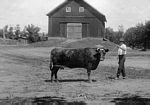
Hill Family Papers go to MHS: The most recent newsletter of the MN Historical Society reports that the MHS is taking possession of Hill family papers. Readers may know that North Oaks was a community that was originally owned as the experimental farm of James J. Hill, the founder of the Great Northern Railroad. (A picture from 1900 from the James J. Hill Reference Library web site--#569--to the right shows the barn on the farm that is still standing.) Some of his descendants live there today. In March 2008, "the Society accepted transfer of the James J. Hill, Louis W. Hill and Maud Van Cortlandt Taylor Hill Papers, 1200 cubic feet of records, from the James J. Hill Reference Library in St. Paul." Hill family foundations are supporting the digitization of the records among other tasks.

Article on manufactured home bill: The Quad Press printed a good article about HF3477, a bill to assist owners of manufactured homes (aka mobile homes). They interviewed the folks at Legal Aid who worked with me on the bill.

Semi-Sesquicentennial: Minnesota turned 150 on Sunday, May 11th, and therefore we are celebrating the state's sesquicentennial. My dad's birthday was the same day and he turned 75. Since he is half as old as the state, that means that we celebrated his semi-sesquicentennial!

Schedule: Say, I forgot to mention last week that on Friday night (the 9th) my kids and I went to visit the original copy of the Declaration of Independence at the MN History Center. I wanted my nine-year old at least to be able to remember that she saw it. The turnout, unfortunately, for this "showing" to public officials and those policy wonk-types was pretty low. I think I was the only legislator there. (There was a reception earlier in the week for legislators and some others.)

On Sunday, my wife and two children walked in the 5K Race for the Cure at the Mall of America. My seven-year old walked the whole way without even whining! There were 50,000 people who participated. They need to work on their event recycling though. :) I wished that those 50,000 people could have written a letter to the Governor asking him to sign the bill that will ban the use in Minnesota of toxic flame retardants like decabromodiphenylether (DBPE), which is present in breast milk worldwide. (The Governor vetoed it this week.)

On Monday the 12th, we started a lengthy floor session on a variety of issues. We got through a bunch of conference committee reports, including bills on regulating dangerous dogs, an omnibus pensions bill, a bill for a constitutional amendment asking voters to allow the creation of a citizen council that would determine legislative pay and per diem, the gestational carrier bill (aka surrogate mother legal issues), adoption records, and some others. The final bill was our major health reform bill--HF3391.

On Tuesday we had a lengthy floor session with lots of stops and starts. We came back Thursday for the same kind of stop-and-start procedure. On Friday, I spoke to a volunteer recognition breakfast at Island Lake Elementary in Shoreview. Then it was off to the floor for a series of bills and caucus meetings until about 10:30 p.m. On Saturday morning we returned at 10:00 a.m. for a session expected to go late into the night and early morning. We ended up recessing at about 11:30 a.m. and I went home to sleep for a few hours, then got called back about 3:30 a.m. on Sunday. We voted on two things and I turned around and went home, got some more sleep, and was back on the floor Sunday morning at 10:00 a.m. A deal was struck early Sunday afternoon and we spent the remainder of the day processing the final bills.

Visitors: lobbyist for Waste Management and National Solid Waste Management Association about conference committee report for HF3506; lobbyist for MN Retailers Association about HF3789 and compact fluorescent bulb education legislation

Constituent contacts: Shoreview resident and Lexington resident supporting medical marijuana legislation; Blaine resident against increase in the minimum wage; Shoreview resident supporting local government health bill; Shoreview resident against gay marriage; Lexington resident against levy limits; three Shoreview residents and Circle Pines resident for HF1875-the statewide health insurance plan for teachers; two district residents and Shoreview resident against newborn DNA testing bill; Circle Pines resident against the Welcoming Schools curriculum that "is indoctrination on gay rights"; Shoreview resident supporting naturopathic doctor registration bill; three Lino Lakes residents supporting HF6, the education finance bill; Lino Lakes resident against using the health care access fund to balance the budget, against state subsidies for the Mall of America, and against public subsidies for a Vikings stadium; two Shoreview residents, Lino Lakes resident, three Circle Pines residents, and Blaine resident supporting health care reform bill; Shoreview resident against income-based property tax relief; district resident supporting tough enforcement of immigration laws

Monday, April 28, 2008

Week of April 27, 2008

Property Tax Refund Calculator: The House Tax Committee has unveiled a property tax bill that will allow for greater property tax refunds for many Minnesotans. It is revenue-neutral, which means that it will not require a tax increase. You can figure out your own property tax refund on-line at the House web site. Click on "Calculate property tax relief proposed in HF3149, omnibus tax bill."

Mall of America: The media has been reporting on a bill that would subsidize the cost of a parking ramp at the Mall of America II project as part of building the new mall. Part of the proposed subsidy would be funded from a pool of money called the "fiscal disparities" program which is 40% of the commercial and industrial property taxes collected in the metro area. My constituents in Anoka County have lower property taxes because of this program, so this mall bill is problematic or me and I find it unacceptable in its current form. I am also not supportive of subsidizing a private business in this way.

Bills pass: The conference committee report on HF3477 passed on the House floor on Monday afternoon. A discussion of this bill dealing with predatory lending protections for manufactured housing owners is in the previous blog entry. It passed 126-3.

One of my other bills, SF2996/HF2903, also passed on the floor on Monday. It would count wastewater effluent as a source of renewable energy in order to promote the use of research of algae for biofuels. Wastewater treatment effluent has a lot of phosphorus in it and that can be used to increase growth in algae that can be used to make biodiesel. Renewable energy status allows producers of this energy to qualify for grants and the like. This bill passed 130-0. Senator Rummel has the Senate version and they are now identical.

Blog article: Several daily newspapers in Greater MN published by Forum Communications carried an article about political blogs and blogs of elected officials this week, and I had a bit quote in it. You can read it on-line.

Burn barrel bill: My bill (HF2802) that would curb open burning of household garbage--the largest source of dioxin pollution in the United States--made some waves in Greater Minnesota this week. The weekly Agri News carried two articles on the bill and about ten farmers have called to share their views. (See "Proposed Ban on Barrel-Burning is Controversial," "Shoreview DFLer Wants Comments on Proposed Burning Ban".)

Health care attitudes: One of the things I really wanted to do in this job is get a better idea from constituents about what kind of change in our health care system that they want, with the end result being health coverage for all, lower costs per capita, and improved quality. It has been frustrating because health care policy is so complicated. MPR did a story on how consumers want change but people are conflicted about what that change should be.

Schedule: On Monday we had a lengthy floor session from about 1:00 p.m. to 11:00 p.m. The major bill was the E-12 education policy bill. We spent a few hours on an amendment on sex education. I've been on record supporting comprehensive sex education as long as there is an opt-out provision should parents and students want an alternative curriculum, and I supported the amendment. Before session I attended a rally by Minnesota film industry workers who were supporting the reinstatement of a rebate for their industry to help attract feature films to MN. A constituent from Blaine asked me to attend and I spoke to a few people at the rally.

On Tuesday, after taking my son to the doctor, I attended a caucus meeting at the Capitol. On Wednesday, we had a floor session from 10:30 a.m. to about 5:45 p.m. covering a lot of smaller bills, including some miscellaneous energy bills. On Thursday, we had a floor session and a caucus meeting. Major bills include the minimum wage bill (I voted in support) and a resolution to Congress supporting the Employee Free Choice Act (I voted in support). We also discussed a bill that would ban the use of decabromodiphenylether (DBPE), a flame retardant that is a persistent bio-accumulative toxin.

Visitors: three people from MN Catholic Conference asking for support of an increase in the minimum wage; grassroots organizers from AFL-CIO presenting letters of support from constituents in support of an increase in the minimum wage; Lino Lakes constituent, labor organizer, and lobbyist together to promote subsidy for Mall of America parking ramp

Constituent contacts: nine constituents sending form letters supporting the Taxpayers' League Tax Cut Petition; Shoreview constituent against "left-wing" agenda of advocates for combatting climate change; Lino Lakes resident against a bill in Congress on immigration; district resident reporting on graduated drivers license issue for Mounds View High School student newspaper; Lino Lakes resident supporting state subsidy for parking ramp at Mall of America II project; Shoreview resident with question about deductibility of federal stimulus checks from state taxes (they are exempt from taxation); Lino Lakes resident against No Child Left Behind; Lino Lakes resident supporting Judge Roy Moore of Alabama; Circle Pines resident against biofuel subsidies and subsidy for Mall of America II project; Shoreview resident supporting private school vouchers; Lino Lakes resident supporting HF4178 for comprehensive school funding; Shoreview resident and Lino Lakes resident against reduced payments to safety net hospitals; Shoreview resident supporting funding for Minnesota Principals' Academy; two Shoreview residents, Blaine resident, and North Oaks resident against subsidy for Mall of America II project; Lino Lakes resident supporting algae-to-biofuels research; Shoreview resident supporting funding for a Minneapolis veterans' home and a Lake Vermillion State Park; Shoreview resident against Central Corridor; Shoreview resident against property tax bill; Shoreview resident against Mall of America II project and supporting enforcing agreements that the state has with Northwest Airlines; Shoreview resident supporting of Staffing for Patient Safety bill for nurses; Shoreview resident supporting Employee Free Choice resolution; Shoreview resident supporting MN Taxpayers League platform; Shoreview resident supporting Rule of 90 pension proposal for teachers; North Oaks resident asking about property tax bill and its affect on seasonal recreation property; Shoreview resident supporting a photo ID to vote; three Lino Lakes residents, Circle Pines resident supporting a citizens council for proposed outdoor funding sales tax revenue allocation; Shoreview resident against current route of the Central Corridor; Shoreview business owner supporting Early Stage Capital Access bill (HF3538); Shoreview resident supporting minimum wage; Circle Pines resident supporting approval of medical marijuana; North Oaks resident, two Circle Pines residents, Lino Lakes resident, two Shoreview residents supporting comprehensive sex education; two Lino Lakes residents and Circle Pines resident against comprehensive sex education; five Lino Lakes residents and Shoreview resident on a teacher pension issue

Monday, January 7, 2008

Week of January 6, 2007

Additional Town Hall Meeting Scheduled: In addition to the Town Hall meeting that Senator Rummel and I will hold on January 23rd at 7:00 p.m. in Lino Lakes, we will also hold a meeting on January 30th at 7:00 p.m. at Shoreview City Hall.

Per Diem: I understand that KSTP-TV did a report on legislators' per diem and how high it is. In a previous post when all the per diem rates were decided, you will see that I voted during a rules debate to force the full House of Representatives to vote on the per diem increase to $77 per day. My own per diem is $35 per day, which is the lowest of any legislator who accepts per diem. So I'm #199 out of 201 current legislators. (#200 is a member who just won a special election, so he hasn't received any regular session per diem yet.)

Postage Returned to State: In 2007, the House alloted $1968.00 in postage for my office. (I suppose it is the same amount for other representatives.) By December 31st, I used just $820.22, which means that $1,147.78 goes back to the state treasury. I still have a bunch of stamps left over too. Anyway, it's not a huge amount, but I saved some for the taxpayer!

Income Growth Report: The U.S. Department of Commerce Bureau of Economic Analysis just reported that Minnesota was number 50 (dead last) in "seasonally adjusted personal income growth" from the second to the third quarter in 2007. You can see a press release and accompanying tables on-line.

Vikings Stadium Talk?: A constituent called me the other night reporting on activities of the Metropolitan Sports Facilities Commission related to a possible new Vikings Stadium. While the chances for a taxpayer-funded stadium in Blaine across the highway from my district seem to have passed (FYI, I was against the stadium and supported a referendum on any proposed Anoka-County only sales tax increase), the team is looking at the possibility of tearing down the Metrodome and building a new stadium. The MSFC is touting a recently completed McGladrey Report showing the economic benefits of sports stadiums. I don't buy it and cannot support taxpayer funding for a football stadium when we have so many other needs right now. There will be an open house and public meeting in Minneapolis on January 16th at 6:30 p.m. Here's a story on the economics of the Twins stadium that will give you a flavor for any future stadium discussion.

Schedule: On Monday, I met with Senator Rummel on issues of mutual interest. In the afternoon, I attended a joint hearing of the House Environmental Finance Committee and the Senate Environment & Natural Resources Finance Committee on wastewater. Speakers included the U of M on its onsite sewage treatment program; the U of M on using phosphorus and nitrogen from wastewater treatment to create algae for biofuels; the U of M on endocrine disruptors and pharmaceuticals in wastewater; and the MPCA on wastewater project financing. In the evening, I attended a meeting and presentation by Education Minnesota members from the Mounds View and Centennial School Districts. The presentation was on their legislative agenda for 2008. Major priorities include a statewide health insurance pool for teachers and the Rule of 90 retirement rules.

On Tuesday, I participated as a Project Citizen judge at Irondale High School in New Brighton. Rep. Knuth, former Rep. Steve Dehler, and I listened to 9th grader presentations on six different issues and how those students would solve a problem. Projects included arsenic in playground equipment, phosphorus in Long Lake, E-waste recycling, the Hennepin County waste incinerator, juvenile detention alternatives, and the Mounds View Community Center. The kids did a good job, although for the rest of the day I found myself using the words "like" and "whatever" a bit too much! During mid-day, I met in St. Paul with a staffer for a Congressional campaign. In the afternoon, I spoke to a group of canvassers for Clean Water Action in Minneapolis about the work of my Drinking Water Source Protection Subcommittee. Later I met by phone with some of my House colleagues about some potential legislation on consumer issues.

On Wednesday, I visited two power plants with members and staff for the House and Senate energy committees. The first was Xcel's Monticello Nuclear Generating Plant. This is one of two nuclear power plants in Minnesota and it generates about 600 megawatts. The second was Xcel's Sherburne County Plant (Sherco) in Becker. This is the largest coal burning power plant in the state at 2,400 megawatts. (Xcel's power plants in MN generate about 15,000 megawatts by comparison, or roughly half the state's electrical capacity.) The comparison was interesting. At the nuclear plant, security was very tight. I don't want to reveal that much about it, but let's just say that security knows where you are at any moment as a visitor and the guards are heavily armed with automatic or semi-automatic weapons! The plant is upgrading so that it can produce about another 90 megawatts over the next few years. Nuclear plants make people nervous because of the possibility of an accident, but the physical footprint of the plant was quite small and the fuel rods are good for about 22 months. The Sherco plant by contrast is a sprawling site with a coal ash landfill and a huge pile of coal (about 400 tons burned an hour), it's dirty, and it is probably the biggest emitter of greenhouse gas gases--mostly carbon dioxide--in the state. As a member of the energy committee, I do the math about our electrical supply. We've set the nation's most aggressive renewable energy goal. We've passed aggressive conservation and efficiency goals. We're investing in alternative technologies. But that still won't replace big existing power plants yet because renewables and conservation won't add up to 100% of our current supply. So the question arises--if carbon emissions from coal plants are now considered really bad, and nuclear power is considered undesirable, what public policy tradeoffs will there be?

On Thursday morning, I attended a meeting in Blaine where Anoka County presented its 2008 legislative agenda. The 2007 one is on-line so perhaps the new one will be on-line soon. Later in the day, I attended a presentation of "checks" to two arts groups in our area that came from the Metro Regional Arts Council. One of the recipients was the City of Shoreview, which got a $1,600 grant for the summer concert series at its pavillion. In the evening, I attended a reception for legislators at a joint meeting of the Metro North, Anoka, and Twin Cities North Chambers of Commerce. I was sort of expecting the chambers to tell us (there were about 15 legislators present) what their platform is but they wanted us to talk.

On Friday, Senator Rummel and I attended a legislative breakfast with the Centennial School District board, administration, and parent advocacy groups. Our education budget in 2007 included a significant down payment on special education mandates for school districts, so Centennial received some much needed funding that way this year. Two other legislators in attendance brought out the issue of "equity", saying that the formula dollars currently allocated should be shuffled differently among school districts without consideration for the number of special education students or those with language issues. Respectfully, this is just code for "I don't want to put in any more money into education," and I've seen these statements before! The most compelling argument for education funding reform is from a groups called P.S. Minnesota, which is suggesting that we need to figure out what it actually costs to educate a child and work backwards from there in the budget process. The Centennial Legislative Action Committee also has a platform available on-line.

Later in the morning, I attended a joint House-Senate hearing on the Minnesota Climate Change Advisory Group (MCCAG), which is recommending policy options for the 2008 legislation on how to combat global warming. The MCCAG gave us tables showing us dozens of ways (no till agricultural crop management, urban forestry, lowering the speed limit, better appliance standards, etc.) to reduce carbon emissions through 2025 and the cost per ton of those reductions. Of particular interest to me are the components that involve recycling, solid waste, and composting. (Recycling gives an extremely big bang for the buck on carbon emission reductions, FYI.) The MCCAG will complete their recommendations by the end of the month.

In the afternoon, I attended another joint House-Senate hearing on state parks and trails from the DNR. The DNR showed us a list of $143,640 in projects that have not been completed due to lack of funding. They include things like facility protection, campground renovation, and the like. In addition, the agency is discussing the possibility of acquiring a new state park on Lake Vermillion for roughly $40 from U.S. Steel, which would otherwise sell the land to developers. Much discussion ensued as to whether we have the money to secure the land and meet the needs of other state parks.

Constituent contacts: North Oaks resident supporting treatment for adolescent depression and school violence; Lexington resident supporting legalization of marijuana for medical purposes; Lino Lakes resident supporting use of lottery proceeds for additional purposes; Lino Lakes resident and Shoreview resident supporting a ban on hunting of mourning doves; four Lino Lakes residents against a ban on hunting mourning doves; Lino Lakes resident supporting the Governor's latest initiative against illegal immigration; North Oaks resident about buckthorn; Lino Lakes resident asking about Met Council rules and procedures; five constituents sending form letter e-mails asking for crackdown on illegal immigration; Lino Lakes resident against taxpayer funding for a Vikings Stadium; Blaine resident about crime issues in her area; Shoreview resident regarding MN Board of Medical Practice; Lino Lakes resident supporting dedicating funding bill for the outdoors

Friday, December 14, 2007

Week of December 9, 2007

Schedule: On Monday, December 10th, I attended a meeting at the MN Center for Environmental Advocacy (MCEA) where a representative of the Michigan Environmental Council presented on a proposed on-line tool for "water withdrawal" permitting. One concern here in MN and elsewhere is that some large-scale users of groundwater (e.g., bottled water plant, ethanol plant) might use too much water so that other residential and agricultural users cannot get enough water. In Michigan, they are proposing that a potential large-scale water user can go on-line and find out whether there is enough water in a particular area. We don't have our groundwater all mapped out in MN so we can't do this yet.

On Wednesday, December 12th, I attended a meeting of the Solid Waste Management Coordinating Board (SWMCB) so I could hear a presentation about a proposed paint product stewardship project. Counties spend a lot of our money to help safely recycle or dispose of our old paint. The state and the metro counties are working with paint manufacturers to see if they can create a system where paint manufacturers can help pick up part of the tab through a consumer fee or incorporating the cost of waste management in the price of the new product. Later in the day I attended a meeting of the House Suburban DFL Caucus and then a DFL House Caucus fundraiser in St. Paul. On Thursday, December 13th, I attended a half-day program by ISAIAH called "Conversation on Health." It was an effort to get supporters of change in the health care system together. On Friday, December 14th, I attended a meeting of the Association of Metropolitan School Districts with about two dozen legislators. The AMSD presented on expected deficits for metro school districts and several superintendents debriefed recent unsuccessful attempts to pass local school levies. Senator Pogemiller and Speaker Kelliher also spoke. Finally, I sat in on a meeting of the East Metro PFC Oversight Working Group, which is monitoring Department of Health efforts to address contamination from 3M chemicals in drinking water.

Visitors: Lino Lakes resident about environment and economic development issues; House researcher on solid waste legislation; committee chair about drinking water issues; House researchers about a health care issue

Constituent contacts: Lino Lakes resident about Lino prison; Golden Lake Elementary parent about education; Lino Lakes resident about heart-healthy initiatives; Lino Lakes resident supporting constitutional amendment to ban gay marriage; Lexington resident wanting tougher penalties for deer-baiting; Circle Pines resident, three Lino Lakes residents, and four Shoreview residents supporting "Free Markets Health Care Petition" that opposes new health care mandates (Minnesota Majority, the organization that organized the health care petition, has five issues that it works on: health care; illegal immigration; gay marriage; sex education; and stem cell research)

Monday, November 5, 2007

Week of November 4, 2007

Schedule: On Wednesday, November 7th, I attended a meeting of the House Environmental Finance Committee on MPCA issues, including wastewater treatment, deformed frogs, ballast water on Lake Superior, and a few other things. On Thursday, November 8th, I chaired the first meeting of the Drinking Water Source Protection Subcommittee in Apple Valley (more below), and visited a compost site in Empire Township (Dakota County) and an industrial landfill in Rosemount as Vice-Chair of the Solid Waste, Recycling & Resource Conservation Working Group. On Friday, November 9th, I attended part of a meeting of the Legislative Coordinating Committee's Subcommittee on Claims as it will discuss possible claims against the state for the 35W bridge collapse. (More below.)

Visitors: On Monday, November 5th, I met with a house researcher and staff from the Department of Health on drinking water issues.

Constituent contacts: North Oaks resident about freezing a credit report; Shoreview? resident about the labor force used for 35W bridge reconstruction; Lino Lakes resident supporting recent energy legislation and the legislature's on-time finish and asking about measures to constrain spending; North Oaks resident concerned about new reporting requirements for water management organizations; Shoreview resident upset about Taxpayers' League President's comments about education; Shoreview resident with shingle recycling question; Shoreview resident asking about tax deductions for education expenses

Interesting You Tube Video: A constituent e-mailed me a link to this You Tube video. It's called "Do You Know 2.0?" It lays out some of the global demographic and information technology trends that will face us in the next few decades, and asks viewers and elected officials to consider how they will take this information into account when supporting education. Especially thought provoking is the idea that we don't actually know what skills students will need 20 years from now, because the world is changing constantly.

Levy results: The White Bear Lake School District is the only school district in 53A that had a levy question up for consideration on election night. Its levy passed and the district will now be able for now to avoid closing several schools and letting go about 100 teachers. Congratulations to the levy advocates.

Smoking Ban Update: Tuesday's Shoreview Press has an article on how the smoking ban is working in the north metro, and I've got some quotes there. (A few of them aren't quite right, but what are you gonna do.)

35W Bridge Replacement Funding: I'm a little confused by the testimony of MnDOT officials and the words to the media by the MnDOT Commissioner. In the Legislative Action Committee that is meeting monthly to monitor funding needs for the new 35W bridge, MnDOT officials say that they have the money they need in order to do both the bridge and other scheduled road and bridge projects. After the committee meeting, the MnDOT Commissioner said that MnDOT will have to delay some road and bridge projects if the committee doesn't approve additional funding. Which is it?

Drinking Water Hearing: The first meeting of my Drinking Water Source Protection Committee was Thursday this week in Apple Valley. The first presentation was on Dakota County's Ambient Groundwater Quality (AGQS) study. Dakota County is the only county to have systematically test private wells, and boy is there a lot of stuff in them. A majority of private wells tested (mostly in the agricultural areas of Dakota County) have nitrates in them from fertilizers as well as the most common pesticides for corn and soybeans. The second presentation was on the Met Council's drinking water supply planning. While the Twin Cities should not end up like Atlanta or the desert Southwest, there is a lot of long-term planning that needs to go on about the sustainability of our water supply. Finally, we had a report from the Environmental Quality Board on sustainability of our drinking water.

35W Bridge Collapse: The Friday hearing on possible claims against the state from the 35W bridge collapse was instructive. Ken Feinberg, who served as special master for The September 11th Victim Compensation Fund, testified about his experience with the 9/11 fund as well as other tragedies. He said that there were several lessons he learned that would be helpful here in Minnesota.

* "Timeliness is critical" and there is "no reason to hold victims hostage" waiting for a cause to be determined in the bridge collapse. The 9/11 fund was distributing funds to victims within 100 days of 9/11. He indicated that if the state decided to compensate the victims of the bridge collapse, there is nothing stopping the state from requesting reimbursement of some or all of the compensation if someone other than the state has liability discovered through the investigation and then is penalized through the court system. So in the meantime, he suggested, the legislature could compensate victims before a cause is determined to deal with health costs, lost work, etc.
* "Simplicity is a virtue." The 9/11 fund dealt with the families of thousands of people who died, and the bridge collapse is dealing with perhaps 100-150 people. Therefore, it might not be necessary to create a special office with staff and other resources to handle compensation here in Minnesota, and an existing state office could handle the process.
* It is up to the legislature as the representative of the people to determine whether the bridge collapse warrants special treatment over other tragedies where victims were not compensated.

Among the options discussed Friday for the bridge collapse were:
1. Raising the tort liability cap currently in statute ($1,000,000, which would be split among 100-150 people) to a higher number just for the bridge collapse.
2. Set up a special compensation fund, then determine what the right amount is for compensation for each victim or survivor and pay accordingly
3. Do #2, but deduct from the state's share the amount of private insurance or any other compensation received for that victim or survivor ("collateral offsets")
4. Do #2, but then ask for reimbursement from victims or survivors if an entity other than the state is found liable

Other legislative blogs: The National Conference of State Legislators (NCSL) has a blog index at "The Thicket." You can find a link to The Thicket in the links section on the right.